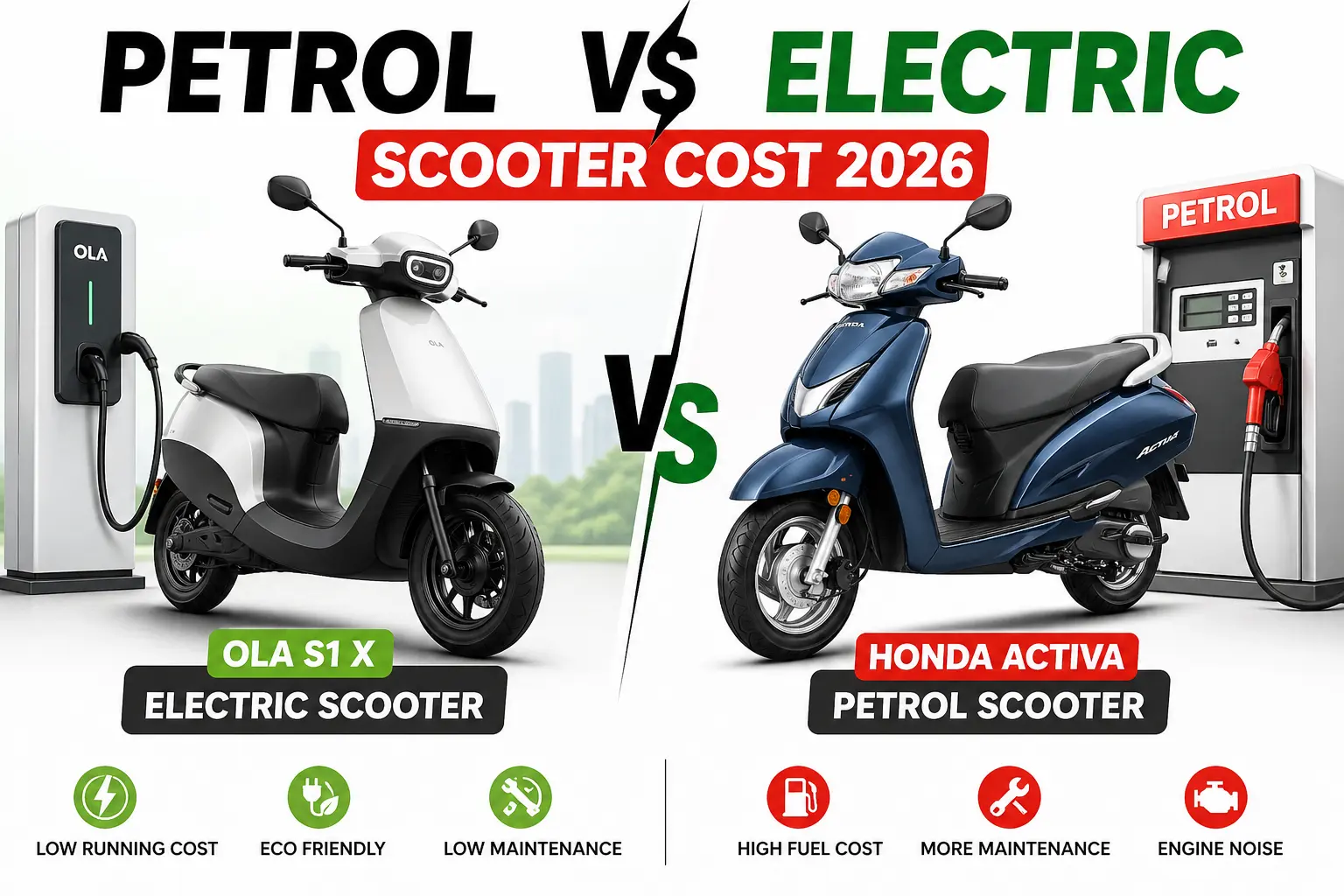
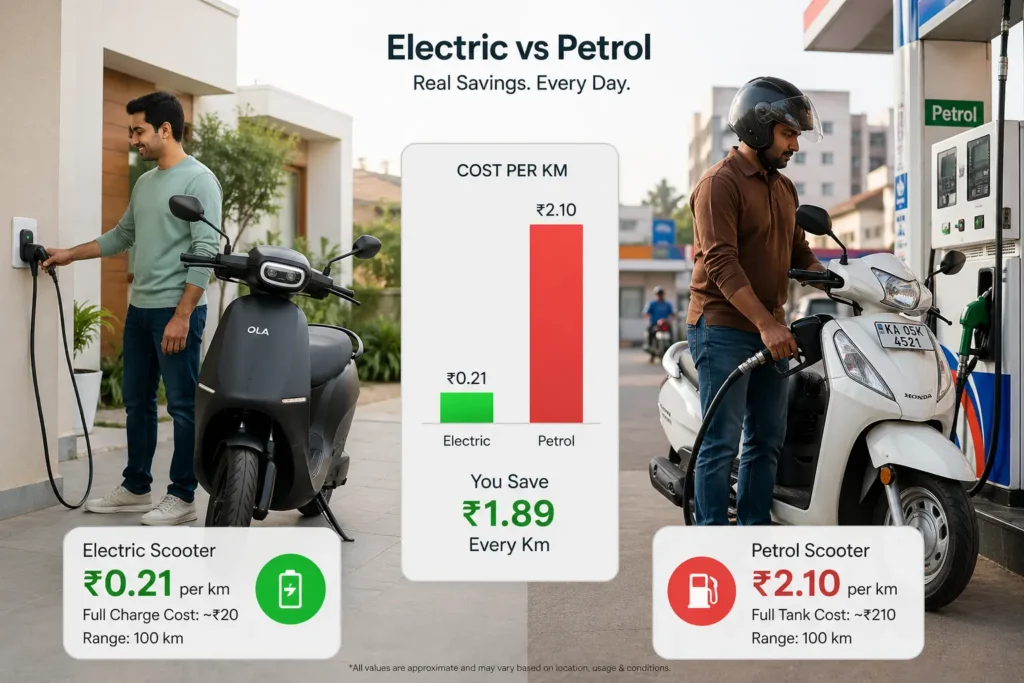
Petrol vs electric scooter running cost in India — this is the one question every two-wheeler buyer in 2026 is asking before signing the dotted line. You’re at a petrol pump paying ₹105 per litre, and the rider next to you just plugged his scooter into a wall socket at home for ₹21. That image sums it up. But the real numbers are more nuanced — and more interesting — than that one scene suggests.
This guide breaks down every single rupee you’ll spend over the lifetime of both scooter types, so you can make a confident, data-backed decision.
Petrol vs Electric Scooter Running Cost India: Why It Matters More Than Purchase Price
Most people in India compare sticker prices when buying a scooter. An entry-level petrol scooter like the Honda Activa 6G starts around ₹74,000, while a popular electric option like the Ola S1 X begins near ₹80,000. The gap feels small. But the real money — the money you spend every month for the next 5–7 years — is the petrol vs electric scooter running cost.
Running cost includes fuel or electricity charges, engine oil, servicing, tyre wear, insurance, and in the case of electric scooters, battery health over time. When you add all of that up across years, the picture shifts dramatically in favour of one clear winner.
Petrol Scooter Running Cost in India (2026 Data)
Let’s start with what most Indians already know and ride — the petrol scooter.
Petrol vs Electric Scooter Running Cost: Fuel Charges Per KM
As of early 2026, petrol prices in major Indian cities hover between ₹103 and ₹108 per litre. Most 110cc–125cc petrol scooters like the Activa, Jupiter, or Access 125 deliver around 45–55 km per litre under real-world city riding conditions.
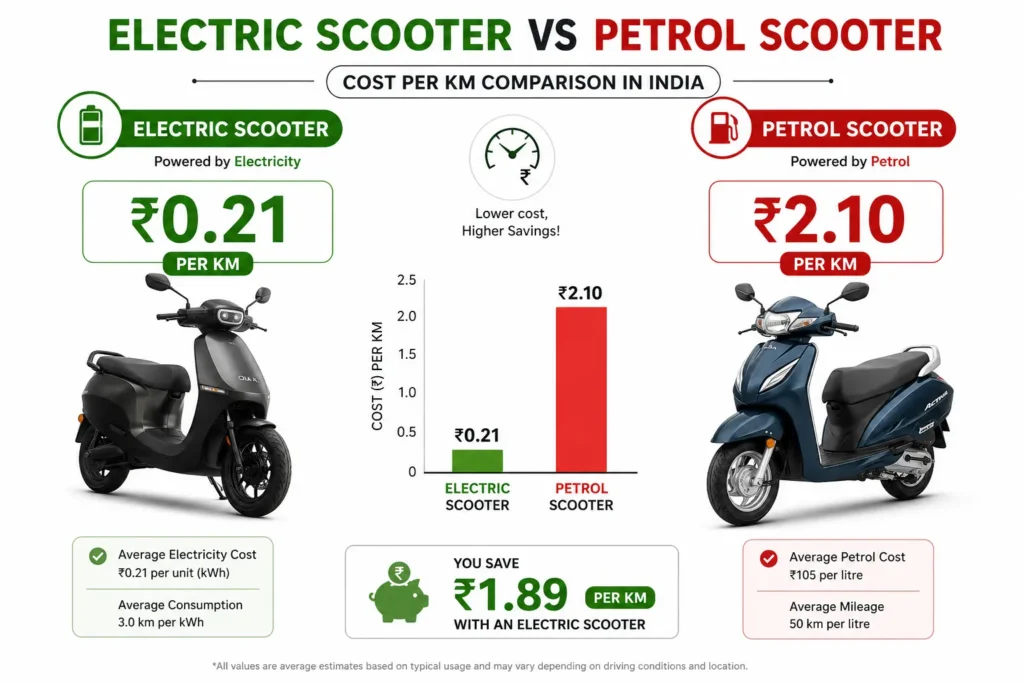
Taking an average of ₹105/litre and 50 km/litre mileage:
- Fuel cost per km = ₹105 ÷ 50 = ₹2.10 per km
For someone riding 40 km per day (a standard city commute), that works out to:
- Daily fuel cost: ₹84
- Monthly fuel cost: ₹2,520
- Yearly fuel cost: ₹30,240
Petrol Scooter Annual Servicing and Maintenance Cost
Petrol scooters need engine oil changes every 2,000–3,000 km, air filter cleaning, spark plug replacement, and periodic brake checks. At an authorised service centre, a standard service costs ₹500–₹800. Add consumables and you’re looking at:
- Annual servicing (4–5 services): ₹3,000–₹4,500
- Engine oil changes (3–4 times): ₹1,200–₹1,800
- Tyres (averaged per year): ₹1,500–₹2,500
- Brake pads, cables, miscellaneous: ₹800–₹1,500/year
Total annual petrol scooter maintenance: ₹6,500–₹10,000
Insurance Cost for Petrol Scooters
According to IRDAI’s 2026 motor insurance guidelines, third-party insurance for a petrol scooter under 75cc costs around ₹538/year. For 75cc–150cc, it’s approximately ₹714/year. Add comprehensive cover and you’re at ₹2,500–₹4,500 annually depending on IDV and add-ons.
Total Annual Petrol Scooter Running Cost (Summary Table)
| Expense Head | Annual Cost (₹) |
|---|---|
| Fuel (40 km/day × 300 days) | ₹30,240 |
| Servicing + Engine Oil | ₹5,500 |
| Tyres & Brake Parts | ₹2,500 |
| Comprehensive Insurance | ₹3,500 |
| Total Annual Running Cost | ₹41,740 |
Electric Scooter Running Cost in India (2026 Data)
Now for the electric side of the petrol vs electric scooter running cost in India equation — and this is where the numbers get genuinely exciting.
Electric Scooter Electricity Cost Per KM
Most mid-range electric scooters in India — Ola S1 Pro, Ather 450X, TVS iQube, Bajaj Chetak — offer a real-world range of 80–130 km on a full charge from a 2.5–4 kWh battery. Home electricity in India costs ₹6–₹9 per unit (kWh) depending on your state slab.
Using a standard benchmark: 3 kWh battery, 100 km real-world range, ₹7/unit electricity:
- Charge cost = 3 kWh × ₹7 = ₹21 for ~100 km
- Electricity cost per km = ₹0.21 per km
That is roughly 10 times cheaper per km than petrol. For 40 km/day:
- Daily electricity cost: ₹8.40
- Monthly: ₹252
- Yearly: ₹3,024
Electric Scooter Maintenance Cost — Far Lower Than Petrol
This is one of the biggest advantages when comparing petrol vs electric scooter running cost in India that most buyers overlook. Electric motors have far fewer moving parts. No engine oil, no fuel injector, no spark plug, no timing belt, no exhaust system to service.
Annual maintenance for an electric scooter typically covers:
- Brake inspection and fluid top-up: ₹500–₹800
- Tyre replacement (same wear rate as petrol): ₹2,000–₹2,500/year averaged
- Software check and suspension: ₹500–₹800
- Miscellaneous (cables, lights, cleaning): ₹300–₹500
Total annual electric scooter maintenance: ₹3,000–₹4,500 — roughly half of a petrol scooter.
Battery Replacement Cost — The Big Question Answered
Every petrol vs electric scooter running cost discussion in India hits this one concern: the battery replacement. Here is the honest picture in 2026.
Most EV scooter batteries carry a 3–5 year warranty or 40,000–70,000 km warranty from Ola, Ather, TVS, and Bajaj. After warranty, a replacement costs ₹25,000–₹60,000 depending on the brand and capacity. Spreading ₹40,000 (midpoint) over 5 years = ₹8,000/year added to your cost.
However, battery technology is improving fast and replacement costs have dropped nearly 35–40% in the past three years alone. Many users riding 40–50 km/day are still on original batteries at the 5-year mark. The Bureau of Energy Efficiency (BEE) also publishes updated EV battery performance standards that further protect consumers.
Total Annual Electric Scooter Running Cost (Summary Table)
| Expense Head | Annual Cost (₹) |
|---|---|
| Electricity (40 km/day × 300 days) | ₹3,024 |
| Servicing + Tyres | ₹3,500 |
| Battery amortisation (5-year avg) | ₹8,000 |
| Comprehensive Insurance (with battery cover) | ₹4,500 |
| Total Annual Running Cost | ₹19,024 |
Petrol vs Electric Scooter Running Cost India: Full Head-to-Head Comparison
Here is the complete petrol vs electric scooter running cost in India breakdown side by side for 2026:
| Cost Factor | 🛵 Petrol Scooter | ⚡ Electric Scooter |
|---|---|---|
| Cost per km | ₹2.10 | ₹0.21 |
| Annual fuel/electricity bill | ₹30,240 | ₹3,024 |
| Annual maintenance | ₹8,000 | ₹3,500 |
| Battery cost (amortised/yr) | — | ₹8,000 |
| Annual insurance | ₹3,500 | ₹4,500 |
| Total Annual Running Cost | ₹41,740 | ₹19,024 |
| 5-Year Total Cost | ₹2,08,700 | ₹95,120 |
| 5-Year Savings (Electric) | ₹1,13,580 saved with Electric | |
Assumptions: 40 km/day riding, petrol ₹105/litre, electricity ₹7/unit, 50 kmpl petrol mileage, 100 km real-world EV range.
Break-Even Point: When Does the Electric Scooter Start Saving Money?
The petrol vs electric scooter running cost in India comparison only makes full sense when you calculate the break-even. Say an electric scooter costs ₹25,000 more upfront than a comparable petrol model. With annual savings of ₹22,716, the break-even arrives in just over 13 months. After that, every kilometre you ride is pure savings.
For anyone riding more than 25–30 km per day, the math clearly favours going electric in 2026. If you’re only doing 10–15 km/day, the numbers are closer and depend more on your local electricity tariff.
Government Subsidies That Reduce Electric Scooter Running Cost Further
The Indian government’s FAME II scheme (Ministry of Heavy Industries) and state-level EV incentives from Delhi, Maharashtra, Gujarat, and Rajasthan directly cut the purchase cost of electric scooters. Benefits range from ₹5,000 to ₹25,000 depending on battery size and vehicle category.
States like Delhi offer additional subsidies of ₹5,000–₹10,000 along with road tax and registration waivers. This further shortens the break-even timeline and strengthens the long-term petrol vs electric scooter running cost advantage of going electric.
👉 Also read: Best Electric Scooters Under ₹1 Lakh in India (2026) — our curated list with real ownership costs.
Charging Infrastructure: Real Ground Situation in India 2026
One of the biggest concerns around petrol vs electric scooter running cost isn’t cost itself — it’s charging convenience. Most electric scooter owners charge at home overnight using a standard 5–15A socket. A full charge takes 4–6 hours. Fast chargers available via Ather Grid, Ola Hypercharger, and IOCL EV stations can top up to 80% in under an hour in major cities.
If you live in an apartment without dedicated charging access, this is a genuine limitation. But it’s changing fast as RWAs and builders adopt mandatory EV charging under new building bye-laws.
Long-Distance and Highway Use: Where Petrol Still Wins
For daily city commutes, electric scooters are the clear winner in the petrol vs electric scooter running cost India battle. For long-distance or interstate riding, petrol scooters still hold an edge in 2026 due to:
- Larger per-tank range: 200–300 km vs 80–150 km per charge
- 3-minute refuelling vs 1–4 hour charging stop
- Dense petrol pump network across rural India
- More consistent performance in extreme temperatures (heat and cold both affect EV range)
For a mixed pattern — city weekdays and 100–200 km weekend trips — an electric scooter still works with some charging planning.
Top Electric Scooters to Consider in 2026 (Running Cost Context)
If this petrol vs electric scooter running cost in India comparison has convinced you to go electric, here are the most popular models and their real ownership costs:
Ola S1 X — Best for Budget Commuters
Starting around ₹80,000–₹85,000, the Ola S1 X with 2kWh battery gives roughly 75–90 km real-world range. A full charge costs ₹14–₹16 at ₹7/unit. Annual electricity cost stays well under ₹2,000 for a 30–35 km daily commuter. Trade-off: Ola’s service network can be patchy in smaller cities.
Ather 450X Gen 3 — Best All-Rounder
Priced around ₹1,30,000–₹1,50,000, the Ather 450X delivers 100–120 km range from its 2.9 kWh battery. Running costs are around ₹0.18–₹0.22 per km. Ather Grid fast-charging in 100+ cities removes most range anxiety. The Ather Connect subscription adds ₹700–₹1,000/year to cost.
TVS iQube S — Best for Tier-2 City Buyers
The iQube S packs a 4.56 kWh battery with 110–130 km real-world range. TVS’s 1,000+ dealer network means service reliability that newer EV brands simply cannot match yet. For buyers outside metros who want EV economics with established-brand reliability, the iQube is arguably the smartest choice in 2026.
Bajaj Chetak Premium — Best for Brand Trust
The Chetak’s IP67-rated battery handles Indian road and weather conditions exceptionally well. Range is 100–110 km. Bajaj’s 4,000+ service touchpoints across India make it the most accessible electric scooter for maintenance. Running costs mirror other EVs, but the ownership experience is closest to a traditional two-wheeler brand.
👉 See our full guide: Electric Scooter Buying Guide India 2026 — Everything You Need to Know Before Buying
Tips to Cut Your Electric Scooter Running Cost Even Further
The petrol vs electric scooter running cost gap is already massive — but you can widen it further with smart habits:
- Charge during off-peak hours (11 PM–6 AM): Many states have lower tariff slabs at night. Savings of ₹1–₹2 per unit can reduce annual charging cost significantly.
- Keep battery between 20–80% for daily use: This slows lithium-ion degradation and delays expensive replacement cycles.
- Use regenerative braking (regen mode): Recaptures kinetic energy in city traffic. Adds 5–10% to effective range.
- Stick to Eco mode on commutes: Sport mode is fun but burns battery faster. Eco mode maximises range and minimises per-km cost.
- Check your household tariff slab: If EV charging pushes your monthly units into a higher slab, factor that real cost into your running cost calculation.
- Service on schedule: Even with fewer parts, skipping annual brake and suspension checks leads to larger repair bills down the line.
Future Outlook: Will the Running Cost Gap Widen?
Petrol prices in India are tied to global crude markets and state tax structures — historically, they trend upward over time. The long-term outlook for petrol running costs is only higher.
For electric scooters, battery prices continue to fall as domestic manufacturing under the PLI scheme scales up. India’s charging infrastructure is expanding rapidly. Electricity tariffs, while state-dependent, are far more stable and predictable than petrol prices. The petrol vs electric scooter running cost advantage for EVs is set to widen every year from here.
Final Verdict: Petrol vs Electric Scooter Running Cost India 2026
The petrol vs electric scooter running cost in India for 2026 tells a clear, data-backed story: electric scooters cost nearly half as much to run annually for the average daily commuter. The per-km cost gap is 10x — ₹0.21 for EVs vs ₹2.10 for petrol. That translates to over ₹22,000 in annual savings and more than ₹1.13 lakh saved over 5 years.
Yes, battery replacement costs are real. Yes, charging infrastructure still has gaps in Tier-3 cities. But for anyone in a metro or Tier-1 city doing 35–50 km daily, the electric scooter is no longer just the greener choice — it’s the economically smarter one by a wide margin.
The petrol pump queue is going to look a lot emptier in a few years. Your wallet will thank you for leaving it early.
Found this breakdown useful? Share it with anyone still on the fence about going electric. Drop your city and daily riding distance in the comments — happy to run the exact savings numbers for your specific situation.
👉 Next read: EV Subsidy in India 2026 — State-Wise List of Benefits You Can Claim Right Now