
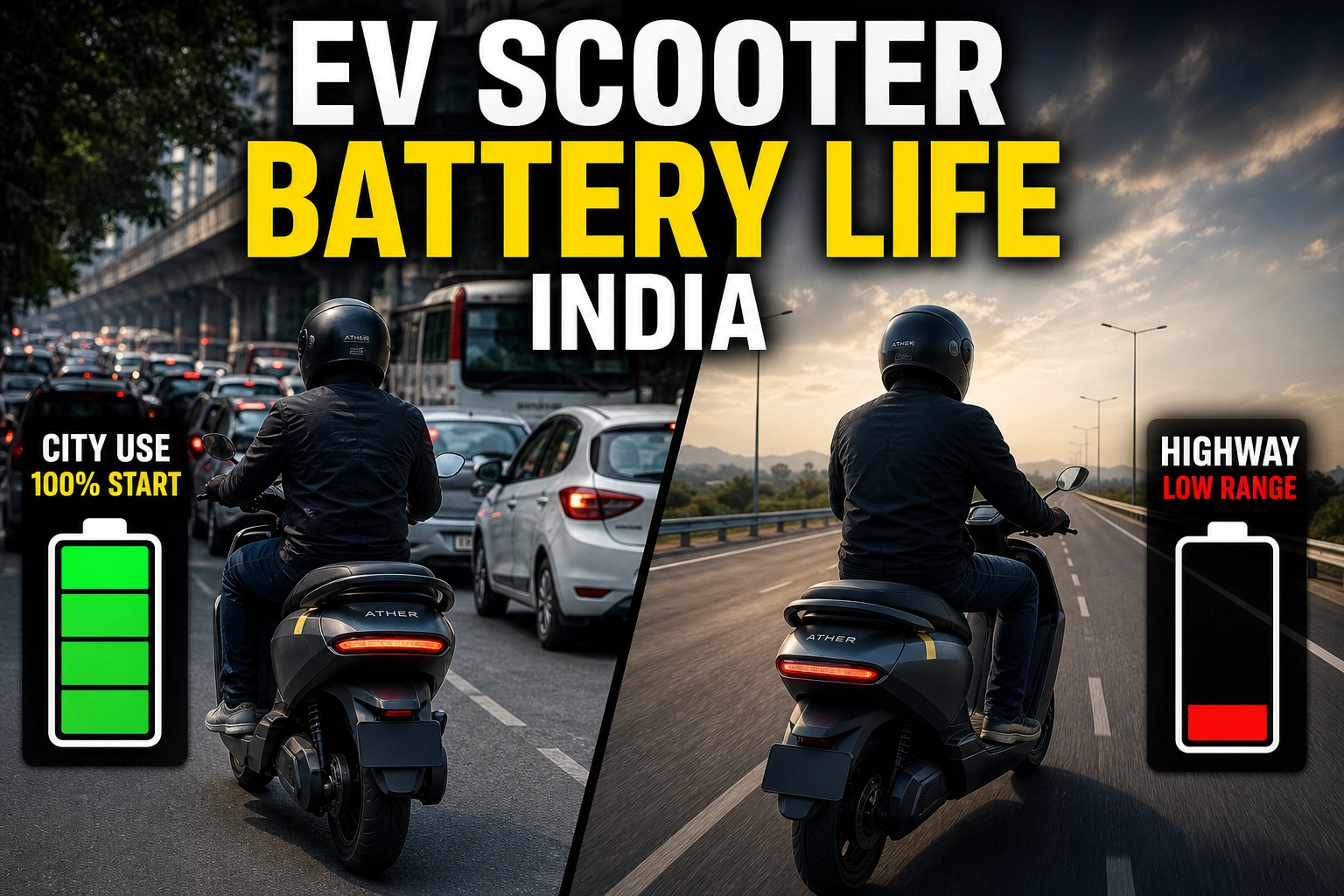
EV scooter battery life India is the single most important factor you should research before buying any electric scooter — yet most buyers completely ignore it until there’s a problem. You spend ₹80,000 to ₹1.5 lakh on an electric scooter, ride it happily for 2–3 years, and then one day the range drops so badly that what used to cover your full commute now barely gets you halfway. That’s battery degradation — and in India’s conditions, it happens faster than manufacturers want to admit.
This guide covers everything: the real EV scooter battery life India riders actually get, what destroys your battery silently, exact replacement costs brand by brand, which scooters hold up best long term, and 7 proven tips that genuinely extend battery life. No filler, no marketing fluff — just what you need to know.
What Is the Real EV Scooter Battery Life in India?
Let’s start with the most important question. Manufacturers claim 5 to 7 years of battery life. The reality? Most Indian EV scooter riders get 3 to 5 years of healthy battery performance, after which noticeable range degradation kicks in.
Here’s how it typically plays out in the real world:
Year 1–2: Battery performs close to advertised range. You’re happy, riding is smooth, no complaints.
Year 2–3: You start noticing the range is slightly lower than when the scooter was new — maybe 10–15% less. Easy to dismiss as weather or riding style.
Year 3–4: Range drop becomes hard to ignore. A scooter that once gave 90 km per charge now gives 65–70 km. Charging frequency increases.
Year 4–5: For budget scooters, this is often when battery replacement conversations begin. For premium scooters with better battery management systems, performance may still be acceptable.
The gap between claimed and actual EV scooter battery life India riders experience exists because manufacturers test batteries in controlled lab conditions — stable temperatures, consistent charging, no dust, smooth roads. None of that describes Indian daily use.
Why EV Scooter Battery Life India Is Shorter Than Global Averages
India is genuinely tough on EV batteries. Here’s why EV scooter battery life India riders get is often shorter than what buyers in Europe or the US experience:
Extreme Heat
Lithium-ion batteries — used in virtually every electric scooter sold in India — start degrading faster above 35°C. Indian cities like Delhi, Nagpur, Hyderabad, Lucknow, and Jaipur regularly cross 44–46°C in peak summer. A scooter parked under direct sun for 8 hours in May can have a battery temperature significantly higher than ambient air temperature. Day after day, month after month, this heat silently accelerates chemical degradation inside the cells.
Heat doesn’t just reduce today’s range — it permanently reduces the battery’s maximum capacity. The damage from summer is cumulative and irreversible.
Dusty and Rough Road Conditions
India’s roads — potholes, unpaved surfaces, speed breakers every 50 metres — force the motor to work harder, which draws more current from the battery. More current draw means more heat generated inside the battery during discharge. More heat during discharge means faster degradation. It’s a cycle that Indian road conditions make unavoidable.
Stop-and-Go City Traffic
Indian city traffic involves constant acceleration from near-zero speeds — traffic signals, lane cutting, pedestrians. Each hard acceleration draws a burst of high current from the battery. Over thousands of such events daily, this wears battery cells faster than steady highway cruising.
Inconsistent Power Supply
In smaller towns and Tier-2 cities across India, voltage fluctuations during charging are common. Unstable voltage during charge cycles adds stress to battery cells, leading to faster capacity fade over time.
Charging Habits
Many Indian riders treat their EV scooter like a mobile phone — plug it in whenever convenient, let it charge to 100%, use fast charging every day. These habits, while innocent-seeming, are among the fastest ways to reduce battery life. More on this in the tips section.
EV Scooter Battery Replacement Cost India: Brand-Wise Breakdown
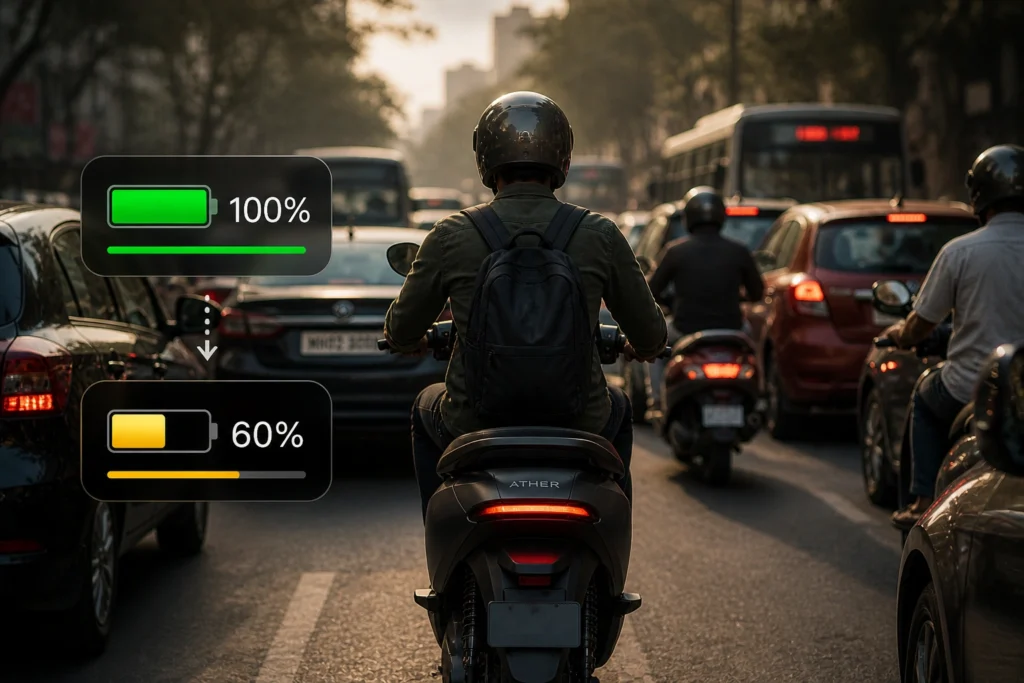
This is the number every buyer should know before purchasing. EV scooter battery life India discussions always eventually lead here — what does it cost when the battery finally gives out?
| Scooter Segment | Popular Models | Battery Replacement Cost |
|---|---|---|
| Budget (under ₹80K) | Hero Electric, Ampere Magnus, Okinawa Lite | ₹15,000 – ₹30,000 |
| Mid-Range (₹80K–₹1.2L) | TVS iQube, Bajaj Chetak, Honda Activa Electric | ₹35,000 – ₹55,000 |
| Premium (₹1.2L+) | Ather 450X, Ola S1 Pro, Vida V1 Pro | ₹60,000 – ₹95,000+ |
For premium scooters, a battery replacement can cost nearly as much as a used petrol scooter. This is not a small expense — it’s a major financial event that can make you question whether the EV purchase was worth it in the first place.
Battery Warranty Coverage: Most reputed brands offer 3 to 5 year battery warranties. However, read the fine print carefully. Most warranties cover the battery only if capacity drops below 70–80% of original. So if your ₹1.3 lakh scooter’s battery degrades to 72% capacity, the brand may argue it’s still within acceptable limits and deny the claim.
Always ask the dealer specifically: “At what percentage of capacity drop will you replace the battery under warranty, and what documentation will I need?”
Which EV Scooter Has the Best Battery Life in India?
Not all EV scooters are equal when it comes to long-term battery health. Here’s an honest look based on actual user experiences:
Ather 450X — Best Overall Battery Life
Ather consistently receives the highest long-term satisfaction ratings for battery performance among Indian EV scooter owners. Their active thermal management system actively controls battery temperature during charging and riding. OTA software updates regularly optimise the Battery Management System (BMS). Ather also publishes battery health data in their app, so you can actually track degradation — a transparency most brands don’t offer.
TVS iQube — Best for Reliability and Service
TVS iQube scores well for consistent long-term performance and benefits enormously from TVS’s nationwide dealer and service network. If a battery issue does arise, you’re not hunting for an authorised service centre — there’s likely one nearby.
Bajaj Chetak — Best for Durability
The Chetak uses a slightly conservative battery setup that prioritises longevity over maximum range. Many Chetak owners report stable, consistent performance well past the 3-year mark. Lower range ceiling means the battery isn’t constantly being pushed to its limits.
Ola S1 Pro — Competitive Tech, Improving Service
Ola’s battery technology is genuinely competitive, and their vehicles have improved significantly with recent OTA updates. Early batches faced criticism around after-sales service, but 2024–25 models have seen better support. Battery tech-wise, they’re in the right tier.
Budget Brands — Variable Results
Hero Electric, Ampere, Okinawa, and similar budget options vary significantly by specific model and batch. Some perform adequately for 2–3 years, others show noticeable degradation within 18 months. The cells used in budget scooters are generally lower grade, and BMS quality is inconsistent.
7 Proven Tips to Extend EV Scooter Battery Life in India
These aren’t generic tips copied from a foreign website — these are specifically relevant to Indian conditions and riding patterns.
Tip 1: Park in shade, always. This single habit can meaningfully extend your battery’s life in Indian summers. Covered parking, a scooter shed, under a tree — anything that keeps the battery temperature lower during peak afternoon heat makes a real difference over years of ownership.
Tip 2: Make slow overnight charging your default. Use your standard home charger plugged in overnight as your primary charging method. Reserve fast charging for when you genuinely need a quick top-up before a long trip. Using DC fast charging every single day significantly increases heat stress on battery cells over time.
Tip 3: Stay in the 20–80% charging range daily. Charging to 100% and depleting to 0% are both hard on lithium-ion batteries. For day-to-day commuting, keeping the battery between 20% and 80% dramatically reduces cell stress. Charge to 100% only when you need maximum range for a longer ride.
Tip 4: Never store with a depleted battery. If you’re not riding for a week or more, store the scooter with the battery at 40–60% charge. A lithium battery left fully drained for weeks can enter a deep discharge state that permanently damages cells and may not recover even after charging.
Tip 5: Keep your scooter’s software updated. This matters more than most people realise. Brands like Ather and Ola regularly push OTA software updates that include BMS optimisations — smarter charging curves, better thermal management, improved cell balancing. An outdated BMS is leaving performance and longevity on the table.
Tip 6: Avoid hard acceleration in peak afternoon heat. Riding aggressively between 1–4 PM in summer generates maximum heat from both the motor and battery simultaneously. If your commute allows flexibility, schedule longer rides for morning or evening hours. If not, at least avoid racing off from every signal.
Tip 7: Don’t skip scheduled service. Battery connections, cooling system checks, cell balancing verification, and charging port inspection are all part of proper EV servicing. Skipping a ₹800 service appointment to save money is a false economy when the downstream cost is a ₹50,000 battery replacement.
Battery Swapping: Is It a Smarter Option for Indian Riders?
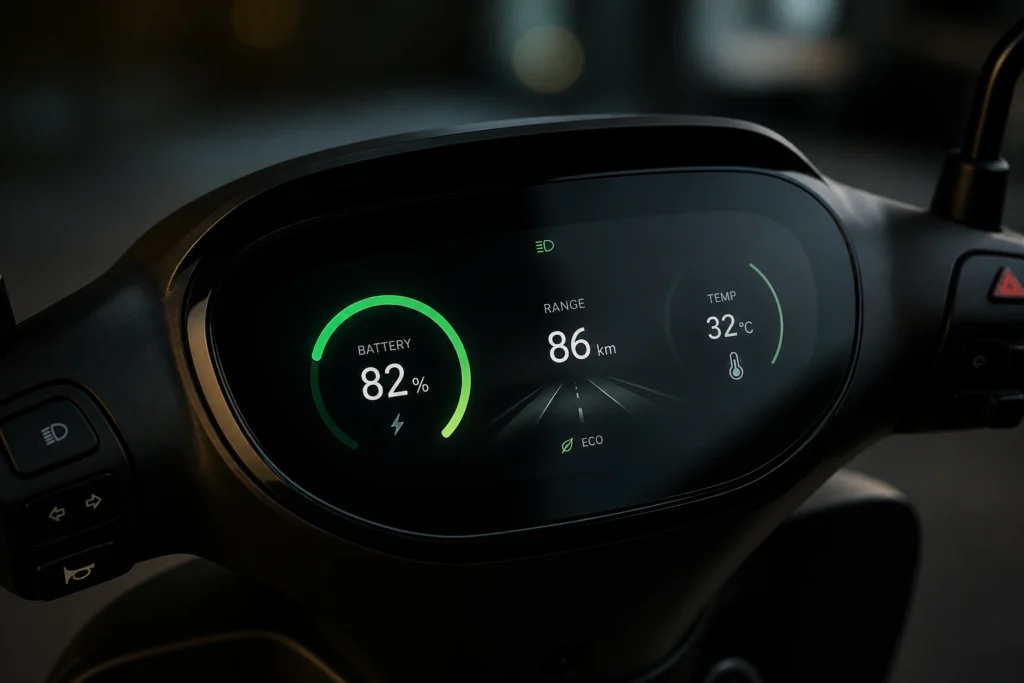
For riders who worry about EV scooter battery life India replacement costs, battery swapping models are worth serious consideration.
Sun Mobility and Bounce Infinity operate swap networks where you don’t own the battery at all — you swap a depleted pack for a fully charged one at swap stations in minutes. No degradation worry, no replacement cost, no home charging infrastructure needed.
The limitation is network coverage. Swap stations are currently concentrated in metros and select Tier-2 cities. For riders in smaller towns, this isn’t yet a practical option. But as the network expands — which is happening steadily — battery swapping could eliminate the battery life concern entirely for high-mileage urban commuters.
Real Cost of Owning an EV Scooter Over 5 Years
Let’s do a complete 5-year ownership cost calculation for a mid-range EV scooter priced at ₹1.1–1.3 lakh:
| Cost Head | 5-Year Estimate |
|---|---|
| Purchase price | ₹1,10,000 – ₹1,30,000 |
| Electricity (25–30 km/day) | ₹12,000 – ₹16,000 |
| Servicing and maintenance | ₹10,000 – ₹15,000 |
| Tyres, brakes, misc. | ₹5,000 – ₹8,000 |
| Battery replacement (if needed) | ₹0 (within warranty) or ₹35,000–₹55,000 |
Best case total running cost (5 years): ₹27,000 – ₹39,000 Worst case with battery replacement: ₹62,000 – ₹94,000
Now compare to a petrol scooter of similar price: fuel alone costs ₹45,000–₹65,000 over 5 years, plus ₹20,000–₹30,000 in engine servicing, oil changes, and parts. Total running cost: ₹65,000–₹95,000 — similar to the EV worst case, but you’re breathing cleaner air and contributing less pollution.
The EV advantage is clearest when the battery stays healthy within warranty. This is exactly why buying from a brand with a solid warranty and strong service network isn’t optional — it’s the decision that determines whether your EV purchase was a smart financial move.
FAQ: EV Scooter Battery Life India
Q: How long does an EV scooter battery actually last in India? Realistically, 3 to 5 years for average riders. Premium scooters with good battery management can stretch to 6–7 years with proper care.
Q: What is the cost of EV scooter battery replacement in India? Budget scooters: ₹15,000–₹30,000. Mid-range: ₹35,000–₹55,000. Premium scooters like Ather 450X or Ola S1 Pro: ₹60,000–₹95,000+.
Q: Which EV scooter has the longest battery life in India? Ather 450X consistently ranks best for long-term battery health due to active thermal management and regular BMS software updates. TVS iQube and Bajaj Chetak are close behind for reliability.
Q: Does fast charging damage EV scooter batteries? Yes, over time. Occasional fast charging is fine. Daily fast charging as your primary method accelerates heat-related degradation noticeably over 2–3 years.
Q: Can I extend my EV scooter battery life in India? Yes, significantly. Parking in shade, using slow home charging, staying in the 20–80% charge range, and keeping software updated are the most impactful habits.
Q: Is battery degradation covered under warranty? Most brands cover defects and capacity drops below 70–80% of original within 3–5 years. Natural gradual degradation is typically not covered. Read warranty terms before buying.
Q: Is battery swapping better than owning a battery? For high-mileage daily commuters in metro cities, yes — it eliminates both the degradation worry and replacement costs. Availability outside metros remains limited for now.
Conclusion
EV scooter battery life India is genuinely good — if you buy smart and maintain properly. The technology has matured enough that riders choosing reputed brands like Ather, TVS, or Bajaj can confidently expect 4–5 years of solid battery performance without spending a rupee extra.
The risks are real but manageable. Know your warranty terms before signing the purchase agreement. Know the replacement cost for your specific model upfront — not as an afterthought when the battery fails. Choose a brand with an established service network, not just the cheapest upfront price. And follow the 7 tips in this guide — they cost nothing but parking strategy and charging discipline, yet they can add years to your battery’s life.
Electric scooters make financial and environmental sense in India right now. Treat the battery right, and it will be the best investment you’ve made in your daily commute.