
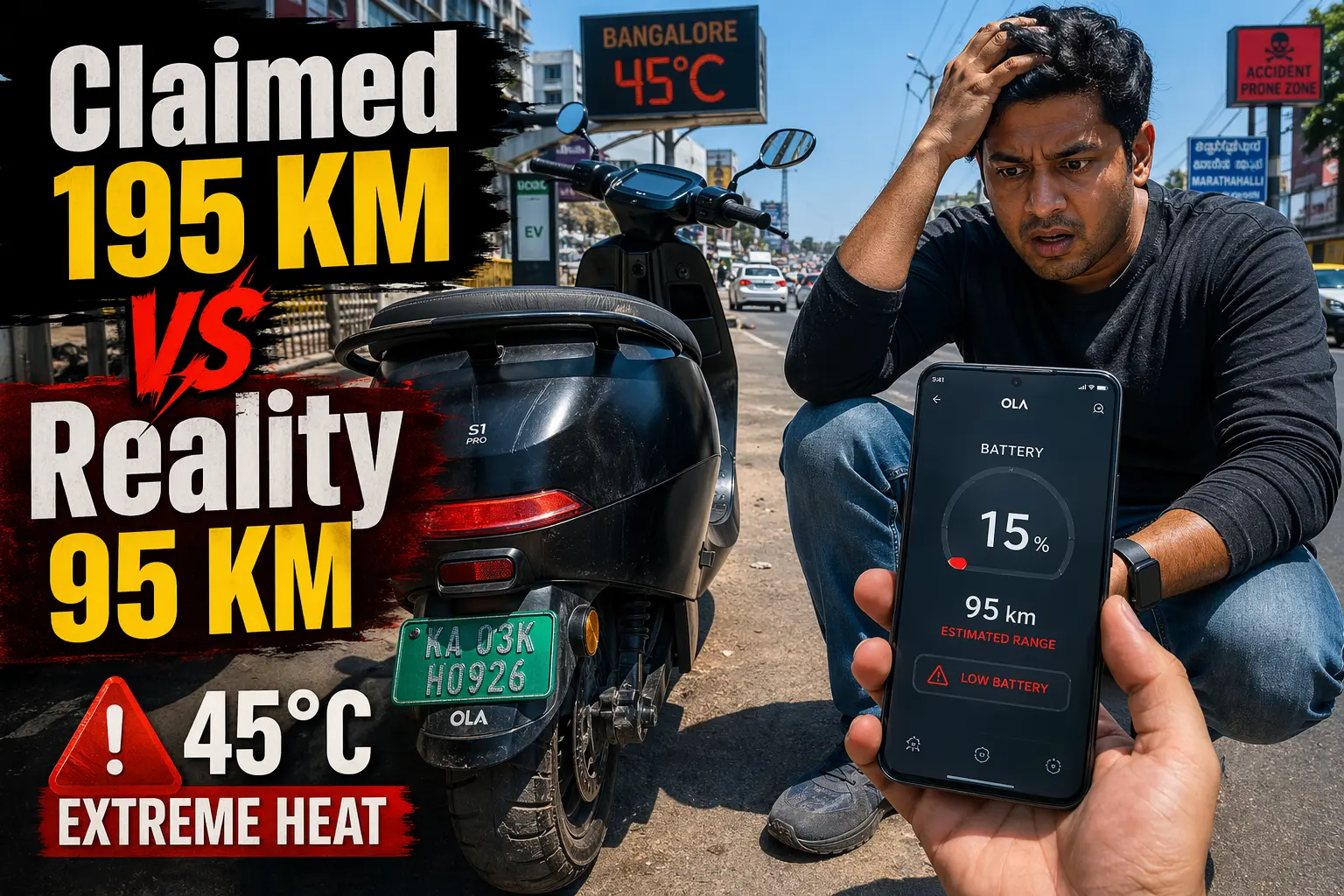
Electric scooter real mileage vs claimed mileage India — this is the one question every buyer asks after bringing home their new EV. You were promised 170 km. You got 95 km. You feel cheated.
You are not alone — and you are not wrong to feel that way.
This article exposes the real mileage numbers of India’s top electric scooters tested in actual Indian road conditions in 2026. We cover Ola, Ather, TVS, Bajaj, and Simple Energy — with real numbers, real rider data, and a practical formula to calculate the electric scooter real mileage vs claimed mileage in India for your own daily commute before you spend a single rupee.
If you are planning to buy an electric scooter in India, reading this could save you from making a very expensive mistake.
Electric Scooter Real Mileage vs Claimed Mileage India: What Is the Difference?
Before the test results, you need to understand one critical fact: every range number a manufacturer advertises in India is measured under the IDC — Indian Driving Cycle standard, tested at certified labs like ARAI India (Automotive Research Association of India).
The ARAI test places the scooter on a rolling road at a controlled 25°C temperature, with zero wind resistance, a fixed 75 kg dummy load, perfectly smooth road surfaces, and zero traffic stops. This is how a brand like Ola legally claims “195 km range” — and it is technically accurate under those lab conditions.
The problem? None of those conditions exist on Indian roads.
This gap between electric scooter real mileage vs claimed mileage India is the root cause of every EV buyer’s disappointment. Kanpur’s 44°C summer heat, Mumbai’s stop-and-go traffic, a 90 kg rider with a pillion — the lab test ignores all of it. Real mileage is always lower, and by a significant margin.
Understanding this difference is not optional — it is essential before buying any electric scooter in India.
5 Shocking Truths: Electric Scooter Real Mileage vs Claimed Mileage India Test (2026)
Here is the data every electric scooter buyer in India needs. These real-world range figures are compiled from owner communities, independent road tests, and verified data from platforms like BikeWale electric scooter reviews and best electric scooters India 2026. All numbers reflect mixed city riding with an average rider weight of 70–80 kg.
Truth #1 — Ola S1 Pro Gen 3: Biggest Gap in the Market
- Claimed Range: 195 km (ARAI IDC)
- Real Mileage — City Traffic: 105–120 km
- Real Mileage — Highway Eco Mode: 150–160 km
- Actual Gap: 38–46% lower than claimed
The Ola S1 Pro is India’s best-selling electric scooter — and also has the widest electric scooter real mileage vs claimed mileage India gap among popular models. City riders in Delhi, Bangalore, and Pune consistently report 105–115 km in daily mixed traffic. The brand tests at very low speeds which inflates the ARAI figure significantly. In highway Eco mode, real range can reach 150–160 km — much more respectable. But if you ride in city traffic daily, expect to get barely 55–60% of the advertised number.
Truth #2 — Ather 450X Gen 4: Most Transparent Brand
- Claimed Range: 170 km (ARAI IDC)
- Real Mileage — City Ride Mode: 100–115 km
- Real Mileage — Warp Mode: 70–80 km
- Actual Gap: 30–40% lower than claimed
Ather Energy is the most honest brand in India’s EV scooter market when it comes to the electric scooter real mileage vs claimed mileage debate. They publish a separate “True Range” figure directly in their connected app, which realistically sits around 105–110 km in standard Ride mode. Check Ather True Range official data for model-specific figures. Aggressive Warp mode usage drops real range below 80 km. For daily commuters riding 30–40 km, the 450X handles 2–3 days comfortably per charge.
Truth #3 — TVS iQube ST: Smallest Honest Gap
- Claimed Range: 145 km (ARAI IDC)
- Real Mileage — City Traffic: 90–105 km
- Real Mileage — Eco Mode: 120–130 km
- Actual Gap: 25–35% lower than claimed
The TVS iQube ST has the most realistic claimed figures of any performance electric scooter in India in 2026. The electric scooter real mileage vs claimed mileage in India gap here is the smallest among performance models — just 25–35% in typical conditions. TVS’s regenerative braking system recovers meaningful energy in stop-and-go city traffic, consistently pushing real range above 100 km for solo city riders. If you want fewer surprises, the iQube is among the most trustworthy options.
Truth #4 — Bajaj Chetak Premium: Most Honest Overall
- Claimed Range: 126 km (ARAI IDC)
- Real Mileage — City Traffic: 85–100 km
- Real Mileage — Sport Mode: 65–75 km
- Actual Gap: 20–30% lower than claimed
Among all popular electric scooters in India, the Bajaj Chetak Premium has the smallest real mileage vs claimed mileage gap. Bajaj has deliberately set conservative claimed figures and tuned the motor for efficiency over performance. City riders in Pune, Jaipur, and Ahmedabad consistently report 90–95 km in everyday use. If you are the kind of buyer who hates being misled, the Chetak is the most honest electric scooter brand in India right now.
Truth #5 — Simple One Gen 2: Best Real Range Despite the Gap
- Claimed Range: 212 km (ARAI IDC)
- Real Mileage — City Traffic: 120–140 km
- Real Mileage — Eco Mode: 170–180 km
- Actual Gap: 30–35% lower than claimed
The Simple One Gen 2 has the highest real-world range of any mainstream electric scooter in India — even with its 30–35% gap from ARAI figures. Its dual-battery system genuinely delivers 120–140 km in city conditions, which is the highest in its class. If absolute real mileage matters most to you, the Simple One wins clearly. For long-distance commuters who ride 60–80 km daily, this is the most practical choice in India’s 2026 EV market.
Why Is Electric Scooter Real Mileage Always Lower Than Claimed in India?
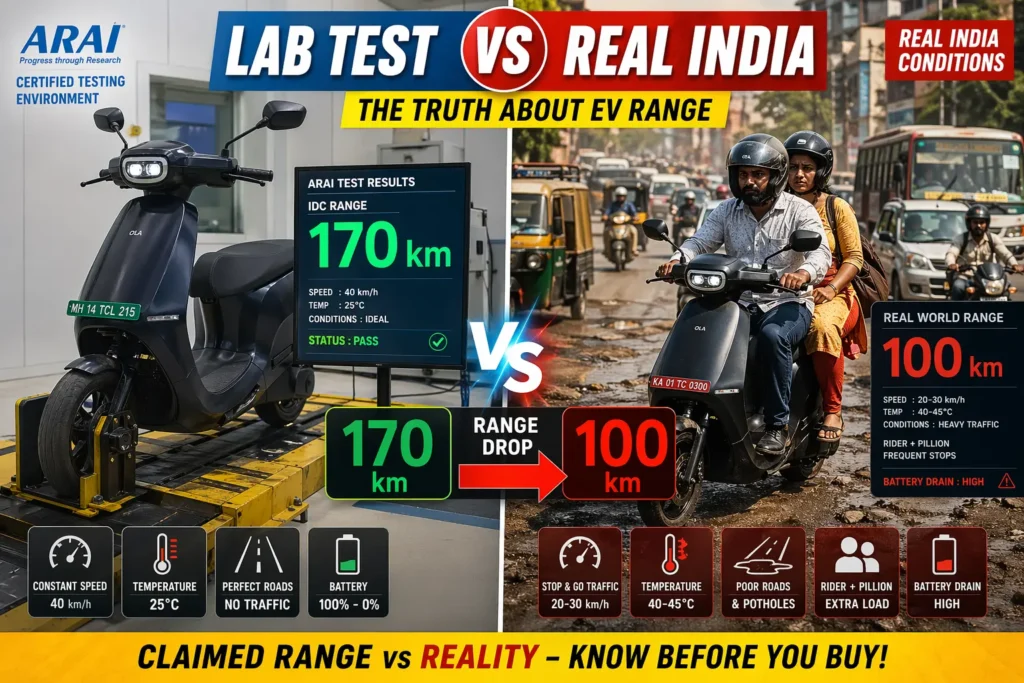
The electric scooter real mileage vs claimed mileage India gap exists because of five real-world factors that ARAI’s lab test completely ignores.
Factor 1 — Indian Road and Traffic Conditions Drain Batteries Fast
India’s city roads destroy the efficiency assumptions of any lab test. Constant acceleration and hard braking at traffic signals, crawling through congestion, and navigating potholes all drain the battery 30–40% faster than the smooth, uninterrupted rolling road used in ARAI testing. Heavy city traffic alone accounts for the largest portion of the electric scooter real mileage gap in India.
Factor 2 — Extreme Summer Heat Kills Battery Capacity
No manufacturer talks openly about this, but it is one of the most critical factors for the electric scooter real mileage vs claimed mileage India comparison. Lithium-ion batteries lose 15–20% efficiency when ambient temperature exceeds 35°C. In cities like Kanpur, Nagpur, and Lucknow, summer temperatures regularly cross 43–46°C. The ARAI test is conducted at 25°C — a temperature that barely exists in North India from April through July. Expect your real mileage to drop noticeably in peak summer.
Factor 3 — Rider Weight and Pillion Load Are Ignored
The standard ARAI test uses a fixed 75 kg load. But riding with a pillion passenger is an everyday reality for most Indian families. Two riders combined weighing 130–150 kg forces the motor to work 20–30% harder, directly increasing battery drain. If you regularly carry a pillion, subtract at least 20% from any claimed range number when estimating the real electric scooter mileage in India for your use case.
Factor 4 — Riding Mode Makes a Massive Difference
ARAI testing is conducted in the most efficient low-speed mode. But most Indian riders, especially younger commuters, spend a significant portion of their rides in Sport or Warp mode. This single factor alone can reduce real mileage by 30–40% compared to the advertised figure. Eco mode riding in city traffic gets you closest to the claimed range — but it is not how most people actually ride.
Factor 5 — Battery Degradation Over Time
A fresh battery delivers 100% of its rated capacity. After 600–800 charge cycles — roughly 2–3 years of daily charging — lithium-ion batteries naturally degrade to 80–85% of their original capacity. This means your electric scooter’s real mileage in India will slowly decrease year over year, even with perfect charging habits. Keeping charge levels between 20% and 80% significantly slows this degradation.
The Honest Formula: Calculate Real Mileage Before You Buy
Do not guess — calculate. Use this correction factor table to estimate the electric scooter real mileage vs claimed mileage in India for your specific riding situation before purchasing.
Formula: Your Real Range = Claimed ARAI Range × Correction Factor
| Your Riding Profile | Correction Factor |
|---|---|
| Highway, solo rider, Eco mode | 0.80 – 0.85 |
| City, solo rider, mixed mode | 0.55 – 0.65 |
| City, two riders, mixed mode | 0.45 – 0.55 |
| City, summer above 40°C, solo | 0.50 – 0.60 |
| Sport or Warp mode daily | 0.40 – 0.50 |
Real Example: Ola S1 Pro claims 195 km. You ride in Kanpur city traffic with a pillion in summer. 195 × 0.50 = ~97 km actual real mileage. That is the honest number you should plan around.
Tip: Always buy a scooter whose corrected real mileage gives you at least 30–40 km more than your daily distance. That buffer handles range anxiety, battery aging, and bad weather days comfortably.
Which Electric Scooter Has the Best Real Mileage Honesty Ratio in India?
Based on the electric scooter real mileage vs claimed mileage India gap data above, here is our honest ranking:
- Bajaj Chetak — 20–30% gap. Most honest brand in India.
- TVS iQube ST — 25–35% gap. Very reliable real-world figures.
- Simple One Gen 2 — 30–35% gap. Best absolute real range.
- Ather 450X — 30–40% gap. Most transparent via True Range app data.
- Ola S1 Pro — 38–46% gap. Best-seller but biggest honesty gap.
6 Proven Tips to Improve Your Electric Scooter Real Mileage in India
Knowing the electric scooter real mileage vs claimed mileage India gap is step one. Getting the most out of your real-world range is step two.
1. Always ride in Eco Mode in city traffic. The speed difference is barely noticeable in congestion but range improves by 15–20 km per charge.
2. Maintain correct tyre pressure every 2 weeks. Under-inflated tyres add rolling resistance that silently drains your battery on every ride.
3. Charge between 20% and 80% daily. Avoid full 100% charges every night — this single habit extends your battery’s healthy life by 2–3 years.
4. Use slow home charging as your daily default. DC fast chargers generate heat that degrades battery cells faster over time. Reserve fast charging for emergencies.
5. Accelerate gradually from traffic signals. Smooth throttle input instead of aggressive bursts can add 10–15 km of real mileage per charge over a full day of city riding.
6. Park in shade during summer months. A battery sitting in 45°C direct sunlight loses stored charge faster and degrades quicker. Free shade saves real money on battery lifespan.
Should You Still Buy an Electric Scooter Knowing the Real Mileage Gap?
Absolutely yes — but go in with your eyes open.
Even accounting for the electric scooter real mileage vs claimed mileage India gap, most scooters deliver 90–130 km of real-world range per charge. The average Indian urban commuter rides just 25–40 km daily. That means even a scooter delivering “only” 95 km of real range covers 2–3 full days of commuting on a single charge.
The financial math remains overwhelmingly in favour of electric. Real-world running costs sit at ₹0.30–₹0.50 per km for electric versus ₹2.00–₹2.50 per km for petrol. For a 30 km daily commute, the saving is still ₹15,000–₹20,000 every single year — gap or no gap.
The key is buying the right scooter for your actual daily distance, not the manufacturer’s claimed figure. Use the formula and correction factors above, add a 30 km buffer, and choose accordingly.
Frequently Asked Questions
Q: What is the electric scooter real mileage vs claimed mileage difference in India on average? In Indian city conditions, real mileage is typically 40–50% lower than the ARAI claimed figure. Highway Eco mode riding can get you closer to 75–80% of the claimed range.
Q: Which electric scooter gives the most honest mileage in India 2026? Bajaj Chetak has the smallest gap — just 20–30% below claimed range. TVS iQube ST is second with a 25–35% gap.
Q: How does Indian summer heat affect electric scooter real mileage? Temperatures above 35°C reduce battery efficiency by 15–20%. In peak North Indian summer (42–46°C), your real mileage will be noticeably lower than in cooler months.
Q: Is real mileage always lower than claimed for electric scooters in India? Yes — always. No electric scooter in India currently achieves its ARAI claimed range under normal city riding conditions. This is a universal industry reality, not specific to any brand.
Q: How can I get maximum real mileage from my electric scooter in India? Use Eco mode, maintain tyre pressure, charge between 20–80%, avoid daily fast charging, park in shade during summer, and ride with smooth gradual throttle inputs.
Conclusion: Know the Real Numbers Before You Buy
The electric scooter real mileage vs claimed mileage India gap is one of the most important facts every Indian EV buyer must understand before spending their money. Brands will always test under perfect conditions. Indian roads will never be perfect. The gap will always exist.
But now you have the real numbers, the honest brand rankings, the correction formula, and the tips to maximise your range. You are a significantly smarter buyer than you were 10 minutes ago.
Electric scooters remain the best financial and practical decision for most Indian city commuters in 2026 — just buy for your real distance needs, not the showroom promise.