
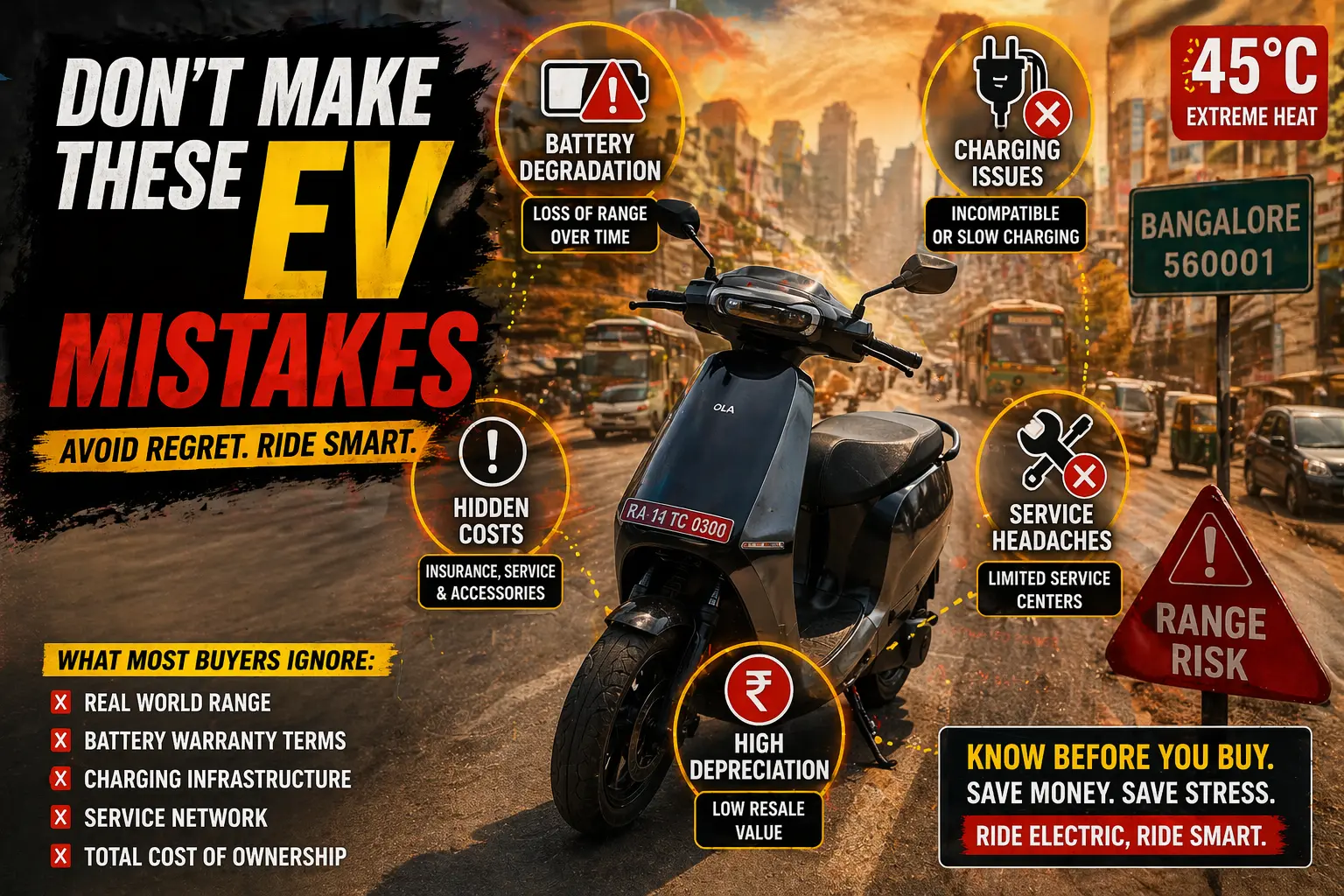
First time electric scooter buyer mistakes India — these three words describe a painful experience that thousands of new EV owners go through every single month. You get excited, you visit the showroom, the salesperson shows you impressive numbers, and you swipe your card. Then reality hits — the range is lower than promised, the service centre is 40 km away, and nobody told you that your apartment building has no EV charging point.
In 2026, India’s electric scooter market has crossed 1.28 million units annually — but alongside the sales growth, buyer regrets are growing too. Most of these regrets come from the same set of avoidable mistakes that first time buyers make repeatedly.
This guide covers 11 of the most costly first time electric scooter buyer mistakes in India — with clear explanations of what goes wrong and exactly how you can avoid each one before spending a single rupee.
Why First Time Electric Scooter Buyer Mistakes India Are So Costly in 2026
An electric scooter in India typically costs between ₹70,000 and ₹1.50 lakh. That is a significant investment for any Indian household. Unlike petrol scooters, EV ownership involves factors that most buyers have never had to think about before — battery chemistry, charging infrastructure, software updates, and government subsidies. Without the right knowledge, first time electric scooter buyer mistakes in India can easily cost you ₹20,000 to ₹50,000 in avoidable losses — through poor model selection, missed subsidies, wrong charging habits, or bad warranty decisions.
The good news? Every mistake on this list is 100% avoidable if you know what to look for. Let us go through all eleven.
Mistake 1: Trusting the Claimed Range Without Checking Real Mileage
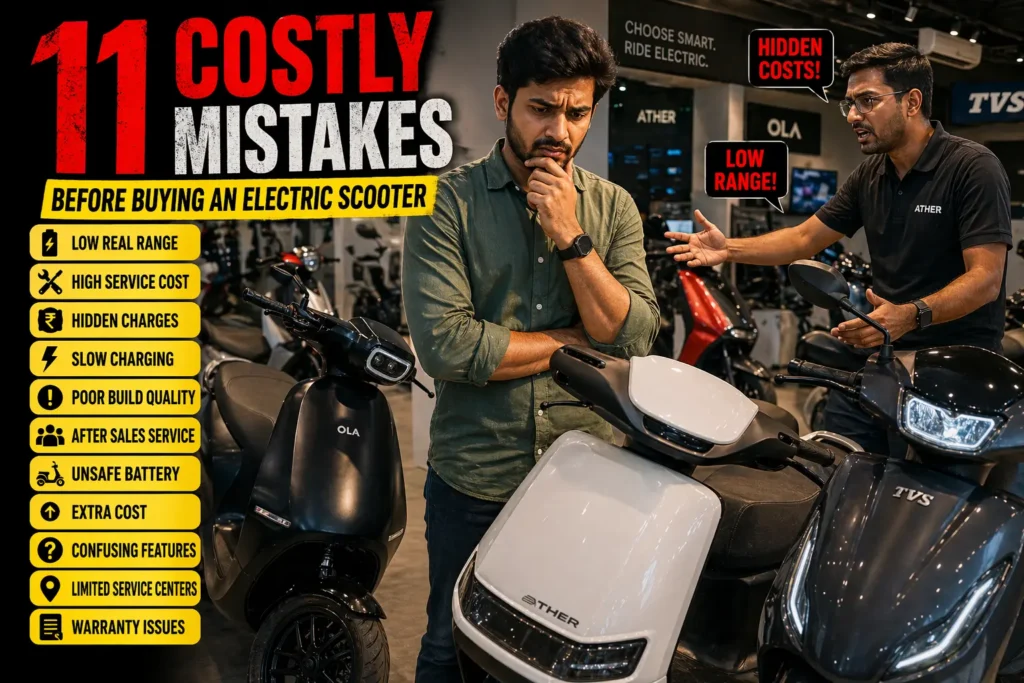
This is the number one first time electric scooter buyer mistake in India — and it causes the most disappointment.
Every electric scooter brand in India advertises an ARAI-certified range tested in a laboratory under ideal conditions: 25°C temperature, smooth road, 75 kg dummy weight, no traffic. When Ola says “195 km range” or Ather says “170 km range,” those numbers come from that perfect lab test. Check ARAI official testing standards India to understand how these tests work.
In real Indian cities — with summer heat above 40°C, heavy traffic, pillion passengers, and stop-and-go signals — real-world range is typically 40–50% lower than the claimed figure.
How to avoid it: Always multiply the claimed ARAI range by 0.55–0.60 to get your realistic city range. If a scooter claims 150 km, expect 85–90 km in actual Indian conditions. Buy a scooter whose realistic range is at least 30–40 km more than your daily commute distance. Read our detailed [electric scooter real mileage vs claimed mileage India] guide for model-by-model real range data.
Mistake 2: Ignoring Charging Infrastructure at Home and Office
The second most common first time electric scooter buyer mistake India first timers make is assuming charging will be easy. It is not always straightforward.
If you live in an independent house with a garage, home charging is simple — just plug in overnight. But if you live in an apartment building on the 5th floor with basement parking and no dedicated power socket near your parking spot, you have a serious problem. Many apartment societies in India still do not have EV charging provisions.
How to avoid it: Before buying, check these three things:
- Does your apartment parking have a nearby power socket or can you get one installed?
- Does your office provide EV charging or allow extension cords?
- Is there a public fast charger within 3–5 km of your home for emergency top-ups?
Only buy if at least your home charging situation is sorted. A scooter you cannot charge conveniently becomes a daily source of stress.
Mistake 3: Not Checking the Service Network in Your City
Poor after-sales service is one of the biggest first time electric scooter buyer mistakes India buyers regret deeply. Unlike petrol scooters, you cannot take your EV to any roadside mechanic for repairs. Electric scooters need brand-authorised service centres with trained technicians and diagnostic equipment.
In 2026, brands like TVS and Bajaj have strong service networks across India, including Tier 2 cities. But some newer brands have service centres only in metros. If you buy a brand with no service centre within 30–40 km of your home, every servicing appointment becomes a major inconvenience — and a breakdown far from home becomes a nightmare.
How to avoid it: Before finalising any brand, search “[Brand name] service centre [your city]” on Google Maps. Verify the service centre actually exists and is operational. Check top electric scooters in India on BikeWale for service network ratings from real owners. Prioritise brands with service centres within 15–20 km of your home.
Mistake 4: Missing Out on Government Subsidies Worth ₹5,000–₹30,000
One of the most financially painful first time electric scooter buyer mistakes in India is buying without knowing or claiming available government subsidies.
In 2026, the central government’s PM E-DRIVE scheme offers subsidies on eligible electric two-wheelers. Several state governments — including Delhi, Maharashtra, Gujarat, and Tamil Nadu — offer additional state-level incentives including road tax waivers and registration fee discounts. Together, these can reduce your purchase cost by ₹5,000 to ₹30,000 depending on your state.
How to avoid it: Before visiting the showroom, research:
- PM E-DRIVE scheme eligibility for your chosen model
- Your state’s EV subsidy policy for 2026
- Whether the dealer processes the subsidy at point of sale or you have to apply separately
Always ask the dealer specifically: “Is this model PM E-DRIVE eligible?” and “What is the subsidised on-road price?” Do not assume the price on the website already includes subsidies.
Mistake 5: Buying Based Only on Price — Ignoring Battery Type
Many first time electric scooter buyer mistakes India beginners make come down to focusing only on sticker price and ignoring the battery chemistry inside the scooter — which directly affects safety, longevity, and long-term cost.
In 2026, most electric scooters in India use either:
- NMC (Nickel Manganese Cobalt) batteries — higher energy density, longer range, but more sensitive to heat and slightly higher fire risk
- LFP (Lithium Iron Phosphate) batteries — safer, more durable in Indian heat conditions, longer cycle life (3,000+ cycles vs 800–1,000 for NMC), but slightly heavier
For Indian conditions — especially North India’s extreme summers — LFP batteries are generally safer and last longer. Brands like Ampere and Bajaj Chetak use LFP chemistry in several models.
How to avoid it: Always ask the dealer: “What type of battery does this scooter use?” If you live in a high-heat region, prefer LFP. If you need maximum range and ride in moderate temperatures, NMC is acceptable. Check best electric scooters India 2026 for battery chemistry details on popular models.
Mistake 6: Skipping the Test Ride
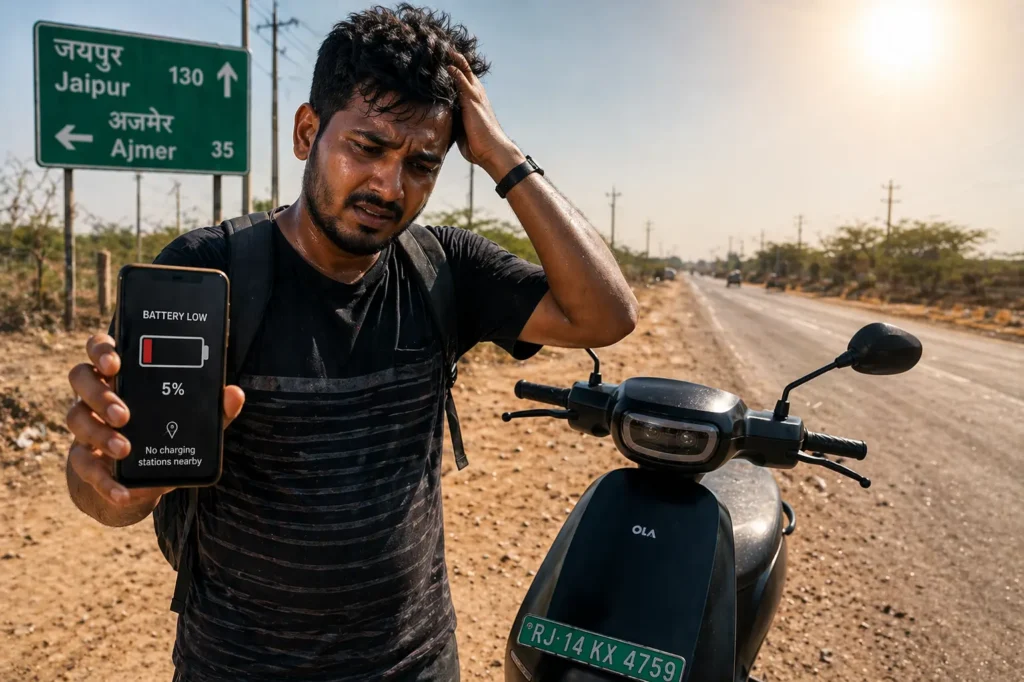
This sounds obvious, but it is one of the most frequent first time electric scooter buyer mistakes India beginners commit. They see the scooter online, watch YouTube reviews, and order it without ever sitting on it.
Electric scooters feel very different from petrol scooters. The instant torque delivery, the absence of engine vibration, the different weight distribution due to the floor-mounted battery — all of these affect how the scooter handles. A scooter that looks perfect online may feel too heavy, too tall, or too twitchy for your riding style on actual roads.
How to avoid it: Always insist on a test ride before paying any booking amount. Ride it on the actual kind of road you use daily — if your commute involves speed breakers, test on speed breakers. If you ride with a pillion, test with a pillion. Do not finalise any purchase without a hands-on test ride of at least 15–20 minutes.
Mistake 7: Not Reading the Warranty Terms Carefully
Warranty misunderstandings are a quietly common first time electric scooter buyer mistake India buyers make — and the consequences are expensive.
Most brands offer separate warranties for the scooter body (typically 2–3 years) and the battery pack (typically 3–5 years or a set number of charge cycles, whichever comes first). The battery warranty usually has conditions attached — it may only cover capacity loss below a certain percentage, and it may be void if the battery was damaged by improper charging, physical damage, or water exposure.
Some buyers discover too late that their battery degradation is “within acceptable limits” and therefore not covered under warranty — leaving them with a battery replacement bill of ₹20,000–₹35,000.
How to avoid it: Read the warranty document carefully before purchase. Specifically check:
- What percentage of battery capacity loss triggers a warranty replacement?
- What charging behaviours void the battery warranty?
- Is water/monsoon damage covered?
- What is the process and turnaround time for warranty claims?
If the dealer cannot answer these questions clearly, that itself is a red flag.
Mistake 8: Ignoring Real Ownership Costs Beyond Purchase Price
A very common first time electric scooter buyer mistake in India is calculating only the purchase price when comparing models — ignoring the real total cost of ownership over 3–5 years.
An electric scooter that costs ₹10,000 more upfront but includes free servicing for 3 years and has a longer-lasting battery may actually be ₹40,000–₹50,000 cheaper over five years than a cheaper model with expensive servicing costs and a battery that degrades faster.
True ownership cost includes: purchase price, insurance, registration, annual servicing (₹2,000–₹5,000/year), tyre replacement every 25,000–30,000 km, and potential battery replacement after year 5.
How to avoid it: Use this 5-year total cost formula before buying: Purchase Price + (Annual Service Cost × 5) + Insurance × 5 + Expected Battery Replacement Cost = True 5-Year Cost
Check our electric scooter maintenance guide India for real servicing cost data across popular brands.
Mistake 9: Choosing a Brand With No OTA Software Update Support
This is a new-age first time electric scooter buyer mistake India that did not exist with petrol scooters — buying a brand that does not support Over-The-Air (OTA) software updates.
Modern electric scooters are essentially smartphones on wheels. Their performance, range efficiency, charging behaviour, and even safety features are managed by software. Brands like Ather and Ola regularly push software updates that fix bugs, improve range, add new features, and even improve motor response — all without visiting a service centre.
Budget brands and some smaller EV manufacturers in India do not support OTA updates. With these brands, bugs and software issues can only be fixed by physically visiting a service centre — and in some cases, never get fixed at all.
How to avoid it: Before buying, ask: “Does this scooter receive OTA software updates?” Prefer brands with documented software update histories. This is especially important for connected features like app connectivity, GPS tracking, and anti-theft systems.
Mistake 10: Buying Without Checking Monsoon and Water Resistance Rating
India gets heavy monsoon rains for 3–4 months every year. Yet ignoring waterproofing specifications is a classic first time electric scooter buyer mistake India riders regret badly when the first rains arrive.
Electric scooters need an IP (Ingress Protection) rating that determines how well the battery, motor, and electronics are sealed against water and dust. A scooter with IP65 rating can handle water jets and heavy rain safely. A scooter with IP54 or lower may suffer electrical damage in heavy monsoon conditions.
Not all budget electric scooters in India have adequate IP ratings — and water damage to the battery or motor controller is expensive and often not covered under warranty.
How to avoid it: Always check the IP rating of any scooter you consider buying. For Indian conditions, aim for IP65 or higher on the battery pack. If the brand does not publish an IP rating, treat that as a warning sign. Ask the dealer specifically about monsoon riding safety.
Mistake 11: Not Researching the Brand’s After-Sales Track Record
The final major first time electric scooter buyer mistake India buyers make is choosing a brand based purely on online reviews of the product — without researching how the brand handles complaints, service delays, and warranty claims after purchase.
India’s consumer courts have seen a significant rise in EV-related complaints since 2023. In documented cases, some brands have taken weeks or months to resolve issues that should have been fixed in days. Poor after-sales experience has been one of the top complaints from EV scooter owners across India in 2025–2026.
How to avoid it: Before buying any brand, search “[Brand name] complaints India 2025” and “[Brand name] service review India” on Google. Check owner forums and communities on Reddit India, Team-BHP, and Quora. Real owner experiences with service — not just the product itself — should heavily influence your brand choice.
Quick Checklist: Avoid All 11 First Time Electric Scooter Buyer Mistakes India
Before you book or pay for any electric scooter in India, run through this checklist:
| # | Check | Status |
|---|---|---|
| 1 | Calculated real mileage (Claimed × 0.55–0.60) | ✅ / ❌ |
| 2 | Verified home/office charging is possible | ✅ / ❌ |
| 3 | Confirmed service centre within 20 km | ✅ / ❌ |
| 4 | Checked PM E-DRIVE and state subsidy eligibility | ✅ / ❌ |
| 5 | Asked about battery type (LFP vs NMC) | ✅ / ❌ |
| 6 | Taken a proper 15–20 minute test ride | ✅ / ❌ |
| 7 | Read full warranty terms for scooter AND battery | ✅ / ❌ |
| 8 | Calculated 5-year total ownership cost | ✅ / ❌ |
| 9 | Confirmed OTA software update support | ✅ / ❌ |
| 10 | Checked IP rating for monsoon safety | ✅ / ❌ |
| 11 | Researched brand’s after-sales track record | ✅ / ❌ |
Only proceed with purchase when all 11 boxes are checked.
Frequently Asked Questions About First Time Electric Scooter Buyer Mistakes India
Q: What is the biggest first time electric scooter buyer mistake in India? Trusting the claimed ARAI range without accounting for real Indian road conditions. Real mileage in city traffic is typically 40–50% lower than the advertised figure.
Q: How do I avoid missing government EV subsidies in India? Research the PM E-DRIVE scheme and your state government’s EV policy before visiting any showroom. Always ask the dealer for the subsidised on-road price specifically.
Q: Is it safe to buy a budget electric scooter in India as a first time buyer? Only if the budget brand has a service centre in your city, a clear warranty policy, a verified IP rating for monsoon safety, and documented owner reviews. Never buy a budget EV scooter from a brand with no service network in your area.
Q: What battery type is best for first time electric scooter buyers in India? LFP (Lithium Iron Phosphate) batteries are generally safer and more durable in India’s high-heat conditions. They last longer in terms of charge cycles and are less prone to heat-related degradation.
Q: Should I take a test ride before buying an electric scooter in India? Always — without exception. Electric scooters feel very different from petrol scooters. Always test ride for at least 15–20 minutes on roads similar to your daily commute before paying any booking amount.
Conclusion: Avoid These First Time Electric Scooter Buyer Mistakes India for a Regret-Free Purchase
The Indian EV scooter market in 2026 is exciting, fast-growing, and full of genuinely excellent options. But it is also full of marketing claims, spec sheet confusion, and service quality gaps that catch unprepared buyers off guard.
Every single one of the 11 first time electric scooter buyer mistakes India covered in this guide is avoidable with the right information. Use the checklist above before your purchase, calculate your real expected range, verify your charging setup, confirm the service network, and research the brand’s real-world owner reputation.
An informed first-time EV buyer in India in 2026 can have a genuinely outstanding ownership experience. An uninformed one is likely to become one of those disappointed reviewers you read on forums before you buy.
Go in prepared. Ride happy.